

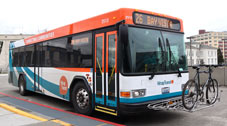
 Routed Buses
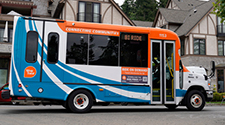 On-Demand/Dial-A-Ride
 Worker/Driver
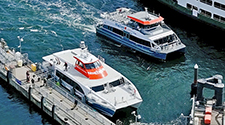 Ferries
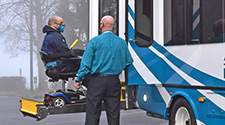 ACCESS & VanLink
 Vanpool, Carpool, SCOOT



 route
route fares
fares maps
maps faqs
faqs Apps
AppsLEARN KITSAP TRANSIT
Environment
Environmental Sustainability
The transportation sector is one of the largest contributors to greenhouse gas emissions. Kitsap Transit plays an important role in reducing the number of single-occupant vehicles on Kitsap County roads and the pollution they generate. In 2025, Kitsap Transit carried more than 3.3 million riders across a multi-modal system of bus, ferry, and rideshare services.
Kitsap Transit is committed to environmentally sustainable practices in its own operations.
 |
 |
 |
CO2 Reductions
|
Energy Consumption
|
Waste Reduction
|

Kitsap Transit’s Charleston Base in Bremerton and North Viking Base in Poulsbo have been registered to International Standards Organization (ISO) 14001:2015 for environmental management systems, effective Sept. 14, 2018. The certification is for public transit vehicle staging, fueling, lubrication, washing, maintenance, dispatch and administration support activities.
Effective September 25, 2019, Kitsap Transit's marine operations at Bremerton Transportation Center also were registered to ISO 14001:2015 for environmental management systems. The certification is for public transit vessel fueling, storage and light maintenance activities.
Effective August 29, 2022, Kitsap Transit's marine operations at The Port Orchard Ferry Terminal also were registered to ISO 14001:2015 for environmental management systems. The certification is for public transit, storage, and light maintenance activities.
Completion of the certification process ensures that Kitsap Transit is at the forefront of environmental management and meeting or exceeding federal recommendations for environmental sustainability.
Kitsap Transit is one of only a handful of transit agencies on the West Coast and one of roughly 3,000 organizations in the United States that are registered to ISO 14001:2015. See our press release. When Kitsap Transit's Charleston Base received ISO 14001:2004 certification in 2015, it was one of just 15 transit agencies across the country awarded certification.
CO2 reduction
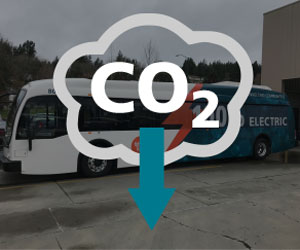
As Kitsap Transit expands service, we remain committed to finding alternative fuels and transportation modes to lower our carbon footprint. With a focus on electric buses, hybrid ferries, propane-powered ACCESS buses, and renewable diesel, we have reduced the carbon intensity of our fuels by up to 22% since 2017.
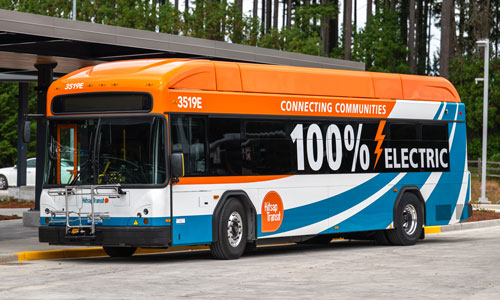
- Electric Buses: The agency put into service its first fully electric bus in 2018. As of January 2025, Kitsap Transit has 29 electric coaches.
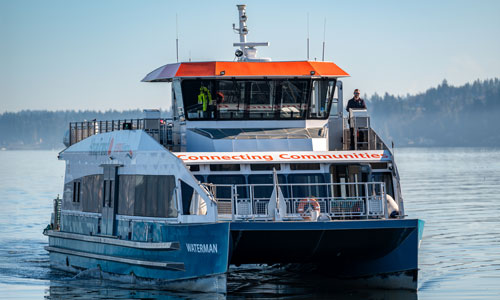
- Hybrid-Electric Ferry: In 2019, Kitsap Transit put into service its first hybrid-electric ferry.
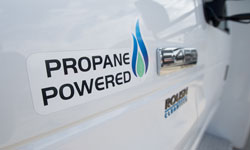
- Propane: The agency introduced propane-fueled vehicles to its fleet in 2015. As of April 2024, Kitsap Transit has 52 propane buses and 4 support vehicles.
- Renewable Diesel: In 2023, Kitsap Transit started using R99 renewable diesel for its routed buses. This diesel lowers emissions by up to 85% compared to standard diesel.
- Newer Buses: In addition to electric coaches, Kitsap Transit has 32 low-Nox propane coaches.
- Idle Time: In 2015, the agency implemented a policy to limit engine idling time to no more than 10 minutes.
A state law effective in June 2018 requires public agencies’ fleets to run on electricity, biofuel or other alternative fuels. Kitsap Transit will be using biodiesel to fuel its diesel fleet.
 |
 |
 |
 |
Hybrid Ferry |
Fully Electric Buses |
Propane-Powered Buses |
More Efficient Diesel Buses |
Regulated Waste | Solid Waste & Recycling
Kitsap Transit is committed to reducing waste and ensuring our staff is efficient with the materials provided to them. As of August 2026, we are projected to reduce the amount of used oil and oil filters by over 1,000 gallons and 4,000 pounds of solid waste.
- fuel oil/waste absorbent materials
- metals, paper and plastic
- bus, automotive and small alkaline batteries
Spill & Stormwater Pollution Prevention
Kitsap Transit set a goal of no petroleum or chemical spills during delivery, storage or dispensing operations. The agency provides operators, maintenance employees and contractors with regular training on spill prevention procedures and rapid-response kits to prevent chemicals and oils from reaching drains at Charleston Base and winding up in waterways where they could harm wildlife.
The agency performs quarterly sampling, color codes stormwater drains on site for easy recognition of pathways, and inspects underground storage tank covers for tightness to ensure no leaks. Kitsap Transit has created standard operation procedures to eliminate stormwater permit violations. The facility has had no spills.
What does ISO 14001 certification mean?
 In 2013, Kitsap Transit was selected to participate in a voluntary, two-year Environmental Sustainability Management System (ESMS) training program through Virginia Tech’s Center for Organization and Technological Advancement and the Federal Transit Administration. At the time, 38 transit agencies across the United States had been selected for the program. The same year, Kitsap Transit's Board committed to an ESMS by adopting an Environmental Policy.
As part of the certification process, Kitsap Transit developed an environmental policy, identified the environmental aspects that have a significant impact on the environment, and set objectives to manage those aspects. The ISO 14001 standard requires an organization to consider all environmental issues relevant to its operations, such as air pollution, water and sewage issues, waste management, soil contamination, climate change mitigation and adaptation, and resource use and efficiency.
When determining the scope of the environmental management system, the agency also considers the needs of interested parties, compliance obligations, risks, its activities, products and services, and commits to continual improvement. Kitsap Transit has an ESMS coordinator who monitors performance and leads an inter-department work group.
|
Environmental Policy Elements:
|
Environmental Aspects:
|
Objectives/Goals:
|
Recent Achievements:
|
Kitsap Transit is committed to being a wise steward of the environment in both its activities and any work done by contractors. Starting in 2014, Kitsap Transit asked contractors doing work at its Charleston Base to affirm their commitment to following our recycling and solid waste disposal guidelines.
Since 2016, Kitsap Transit has required all vendors bidding on products or services being purchased by Kitsap Transit to provide documentation of waste disposal in connection with working on the agency’s projects.
The ISO certification standard was revised in 2015. To meet the revised standard, organizations must demonstrate that top leadership is committed to environmental sustainability in business decisions and include interested stakeholders in their decision-making processes. Kitsap Transit met this standard by, among other things, surveying the community about its priorities for environmental protection.
 |